
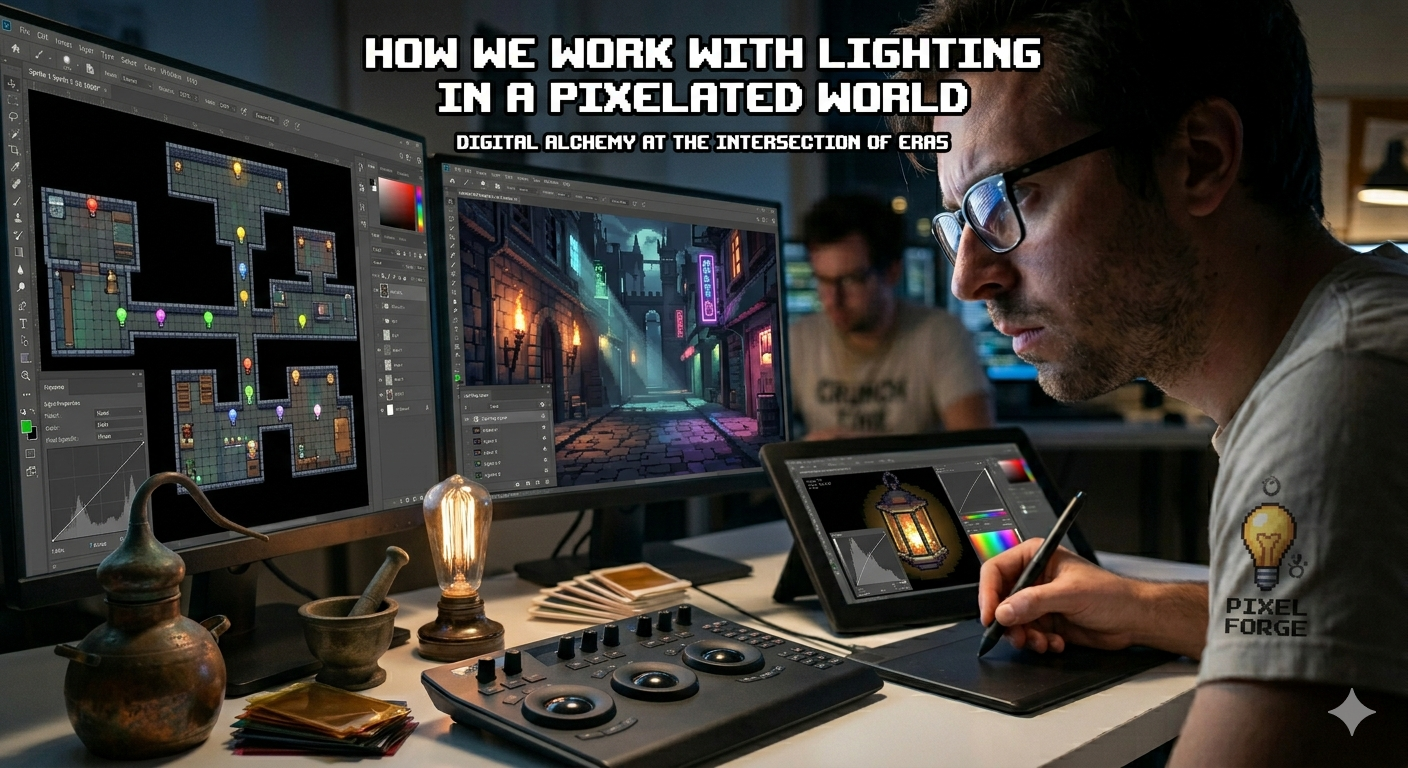
Когда речь заходит о пиксельной графике, многие представляют себе плоскую картинку из прошлого, где каждый цвет намертво привязан к спрайту. В эпоху DOS освещение было статичным: художники вручную рисовали тени и блики прямо на текстурах стен и монстров. Но мы в PixelForge Interactive не зря называем свою студию технологической кузницей. На дворе 2026 год, и наши бумер-шутеры используют технологии, о которых разработчики оригинального Doom или Blood не могли даже мечтать.
В этой статье мы приоткроем двери в наш технический цех и расскажем, как мы заставляем передовые системы динамического освещения работать на благо олдскульного пиксель-арта. Это не просто рассказ о технологиях — это демонстрация того, как наш кастомный движок создает густую, осязаемую атмосферу, которая заставит вас с головой погрузиться в игру и станет главным козырем для привлечения игроков.
Проблема двух миров: Почему современный свет ломает пиксели?
Если вы просто возьмете стандартный современный источник света (например, из Unreal Engine или Unity) и направите его на стену с низким разрешением, магия ретро мгновенно разрушится. Современный свет рассчитывается попиксельно для экранов высокого разрешения (Smooth Shading). На пиксельной текстуре это выглядит чужеродно: мягкие, идеально гладкие градиенты света ломают эстетику крупных «кубиков», превращая стильную игру в небрежную поделку.
Чтобы решить эту проблему, инженеры PixelForge разработали собственную гибридную систему. Мы берем физическую точность современного света и принудительно заставляем её подчиняться законам пиксельной сетки.
Три столпа пиксельного света в PixelForge
Наш подход к иллюминации кибер-готических арен базируется на трех уникальных технологических решениях:
Пикселизированное затененение (Pixelated Lightmaps & Shaders). Наш движок рассчитывает освещение не для пикселей вашего монитора, а для «пикселей» самой текстуры. Мы используем кастомные шейдеры ступенчатого градиента (Cel-Shading / Posterization). Свет на стенах и объектах распространяется не плавно, а четкими, видимыми слоями (ступенями). Если лампа излучает красный свет, то на стене вы увидите красивый, резкий переход от ярко-алого к бордовому, а затем к полной темноте, где каждый слой идеально совпадает с размером пикселя текстуры. Это сохраняет брутальный, олдскульный вид, но делает картинку живой.
Динамический импакт-свет (Dynamic Emission). Каждый выстрел, каждый взрыв и каждый пролетающий плазменный снаряд в наших шутерах является реальным источником света. Когда вы нажимаете на курок двустволки, мощная вспышка дульного пламени на долю секунды озаряет коридор яростным оранжевым светом. Вы видите, как от вспышки мгновенно удлиняются тени от колонн, а пиксельные туши монстров зловеще подсвечиваются из темноты. Это создает невероятный визуальный отклик и усиливает то самое «мясное» ощущение от стрельбы, о котором мы так много говорим.
Объемный туман низкого разрешения (Low-Res Volumetric Fog). Чтобы воссоздать атмосферу мрачного склепа или заброшенного индустриального завода, мы используем трехмерный объемный туман и световые лучи (God Rays). Но и здесь мы применили пиксельный фильтр. Свет, проходя сквозь задымленные помещения, рассеивается крупными, осязаемыми световыми кластерами. Пробивающийся сквозь вентиляционную решетку луч света выглядит как монолитная, пульсирующая пиксельная структура, сквозь которую эффектно пролетают трассеры ваших пуль.
Как наше освещение завлекает покупателей и меняет геймплей?
Мы в PixelForge Interactive не используем графику ради графики. Наш свет — это полноценный инструмент геймдизайна, который работает на две главные цели:
Абсолютная тактическая читаемость: Благодаря контрастному свету и четким границам теней, вы мгновенно считываете геометрию уровня на бешеной скорости. Вы периферийным зрением видите динамическую тень монстра, которая выползает из-за угла до того, как появится сам враг. Это дает вам те самые милисекунды на реакцию, которые спасают жизнь в хардкорном бою.
Глубокая атмосфера без потери FPS: Поскольку наш свет рассчитывается по оптимизированной ступенчатой сетке, он не нагружает вашу видеокарту так, как тяжелый фотореалистичный Ray-Tracing. Наши игры выдают стабильные 144+ FPS даже в самые жаркие моменты боя, обеспечивая бритвенно-острый контроль над персонажем.
Мы не просто красим стены — мы управляем вашими эмоциями. Мы заставляем вас всматриваться в пиксельную темноту, пугаться динамических теней и испытывать восторг от каждого взрыва, который на мгновение ослепляет арену. Мы куем визуал, который уважает классику, но дышит технологиями будущего.
How We Work with Lighting in a Pixelated World: Digital Alchemy at the Intersection of Eras
When it comes to pixel art, many imagine a flat image from the past, where each color is permanently baked onto a static sprite. In the DOS era, lighting was strictly pre-rendered: artists manually painted shadows and highlights directly onto wall and monster textures. But at PixelForge Interactive, we don’t call our studio a technological forge for nothing. It’s 2026, and our boomer shooters utilize rendering technologies that the developers of the original Doom or Blood could only dream of.
In this feature, we throw open the doors to our engineering department to showcase how we force cutting-edge dynamic lighting systems to serve old-school pixel art. This isn\’t just a technical breakdown—it\’s a demonstration of how our custom engine crafts a thick, tangible atmosphere that guarantees absolute immersion and serves as a primary selling point for our titles.
The Clash of Two Worlds: Why Modern Light Breaks Pixels
If you simply take a standard modern light source (from Unreal Engine or Unity, for instance) and cast it onto a low-resolution wall texture, the retro magic instantly evaporates. Modern lighting is calculated per-pixel for high-resolution screens using smooth shading interpolation. On a retro pixel asset, this looks alien: the soft, perfectly smooth light gradients clash with the hard edges of the large \”square blocks,\” turning a stylish game into a sloppy mess.
To solve this dilemma, PixelForge engineers developed a proprietary hybrid rendering pipeline. We harness the physical accuracy of modern lighting engines and forcefully bend it to obey the laws of a low-res pixel grid.
The Three Pillars of PixelForge Light Architecture
Our approach to illuminating cyber-gothic arenas is welded onto three unique technological breakthroughs:
Pixelated Lightmaps & Custom Shaders. Our engine doesn\’t calculate lighting for the native pixels of your physical monitor; it calculates it for the \”pixels\” of the game\’s textures. We deploy custom stepped-gradient shaders (Cel-Shading / Posterization algorithms). Light traveling across structural surfaces doesn\’t blend smoothly—it steps down in sharp, visible bands. If a fixture emits neon red, you will witness a crisp, stylized transition from bright crimson to dark burgundy, and finally into pitch black. Every band matches the native texel size, preserving the brutal old-school look while making the world feel reactive.
Dynamic Kinetic Emission. Every muzzle flash, every rocket blast, and every flying plasma orb in our shooters acts as a true, real-time light source. The exact millisecond you pull the trigger of our double-barrel, an intense flash violently illuminates the corridor with an aggressive orange hue. You watch as geometry shadows instantly stretch along the architecture and enemy sprites warp with zloe-looking silhouettes out of the darkness. This delivers spectacular visual feedback, maximizing the \”meaty\” impact of our gunplay.
Low-Resolution Volumetric Fog. To cultivate the suffocating mood of a gothic crypt or an industrialized refinery, we utilize full 3D volumetric fog and light shafts (God Rays). Naturally, we routed this through a heavy pixelation filter. Light fracturing through smoke-filled spaces scatters into large, tangible voxel clusters. A sunbeam breaking through a heavy iron ventilation grate looks like a solid, pulsating pixelated monument, perfectly traced by the glowing projectiles of your weapon fire.
How Our Lighting Pipeline Captivates Buyers and Dominates Gameplay
At PixelForge Interactive, we completely ban graphics for the sake of graphics. Lighting is a mechanical game design tool that guarantees two core objectives:
Absolute Tactical Readability: Thanks to heavily contrasted shadows and sharp light boundaries, your brain processes arena layouts at breakneck speeds. Your peripheral vision registers a dynamic monster shadow creeping around a concrete pillar before the physical asset even steps into view, granting you those life-saving milliseconds to react.
Thick Atmosphere with Unlocked Framerates: Because our light matrices are processed across optimized, stepped stepped-grids, they don\’t bottleneck your GPU the way unoptimized photorealistic ray-tracing does. PixelForge shooters maintain a locked, buttery-smooth 144+ FPS even during the most chaotic combat loops, ensuring pristine mechanical response.
Мы don\’t just color walls—we manipulate your adrenaline. We force you to stare nervously into pixelated voids, respect moving silhouettes, and experience absolute euphoria from every blast that momentarily blinds the arena. We forge a visual template that honors the classics but operates on the engine architecture of tomorrow. Welcome to PixelForge—where even the darkness is engineered to perfection.
Добавить комментарий